

Engineering company Weir works with miners to deliver innovative mining technology solutions. In this Q&A with Mining Magazine, the company details its approach to digitization in the sector. All responses attributable to Ole Knudsen, Weir Minerals, Senior Director – Digital unless otherwise stated:
Q. How does Weir support the mining industry in getting insights from data?
Firstly, mining houses need to recognise that to take full advantage of the benefits digitalisation can provide, they need to have proper strategy and foundation for the convergence of information technology (IT), operational technology (OT) and the Industrial Internet of Things (IIoT).
Take, for example, condition monitoring solutions, which provide a holistic view of the equipment from a health and performance perspective. Weir’s intelligent solutions integrate multiple data sources from IIoT sensors on the equipment and the process around it, as well as back-end data sources, such as its ERP (enterprise resource planning), engineering systems, and product master data systems.
This approach – i.e. integrating multiple data source – allows Weir to build intelligent formulas that provide actionable insights, recommendations and event intelligence beyond what any typical condition monitoring system can do.
And as an OEM, Weir is able to integrate data from, say, a WARMAN® pump curve and maintenance schedules, combined with the live IIoT sensor data from a pump to deliver an algorithm able to generate predictive recommendations on equipment operation e.g. when to replace a part, what is the lead time etc.
These recommendations are then automatically ‘pushed’ to the customer or, Weir service staff, alerting them to a potential problem ahead of time, as well as recommended actions to take.
These individual pieces of intelligent equipment can then be made to talk to each other, allowing for the optimisation of entire flowsheets.
Q. How close are we to running autonomous operations in mine sites, and what is the technology that facilitates that?
It depends what we mean by ‘autonomous.’ For instance, it’s quite common for underground mines to have their haul trucks operated from a control room on the surface. But it’s probably more accurate to think of this as remote operation with some partial autonomy. It does not take into account that human intervention is still typically required to order spare parts and book in servicing, etc.
While this kind of partial autonomy is becoming more mature in the haulage space, we have for years seeing similar “auto-pilots” being widely adopted in the processing plant with the advanced process controls solutions (APC’s or Expert Systems). However, with new AI based technologies we now see a desire of taking plant control and optimization to the next level of autonomy.
Weir recently acquired SentianAI, a software developer that uses advanced AI and machine learning to continuously learn and adapt to the dynamic processes within a mine, providing continuous improvement and optimisation over time.
It’s a system that can be applied in stages as data quality improves and operator confidence increases. At this stage, Weir’s intelligent solutions can make recommendations to an operator, but we’re – and the industry, more broadly – moving towards a high degree of autonomous control system of, say, the mill circuit. But this is a journey rather than something that is going to happen overnight, which is important because it’s vital that operators are able develop confidence in these systems before committing to fully autonomous control.
Before the industry can embrace true autonomous operations, from process control to closed loop operations, there is a lot more work that needs to be done around data governance and policies, regulatory and legal frameworks and, most importantly, people and change management.
“
“This is a journey rather than something that is going to happen overnight, which is important because it’s vital that operators are able develop confidence in these systems before committing to fully autonomous control.”
Q. As an OEM, how do you adapt your technology offering for different customers’ needs?
No one serves as many mines as Weir, so we’re close to our customers, working alongside them every day. This means we understand their operational challenges and have an existing service network to support them. And digital solutions are mainly an extension of this.
We take a customer-centric approach. First we understand their pain points, then we outline a plan for how we can harness digital technologies to improve equipment and process efficiency and/or their servicing requirements. Each customer is different, and we tailor solutions to their specific needs.
We have platform partners, like AVEVA PI, that are as close to industry standard as possible, which makes integrating with our customers systems relatively straightforward.
Q. What are some of the advantages of using AI to get insights from data?
Miners have a lot of data but are not currently utilising it to its full potential to extract valuable insights. Similarly, OEMs have a wealth of design, manufacturing and operational data. We’re now beginning to see that AI is going to be a game changer when it comes to extracting value from large datasets, which is one of the reasons Weir recently acquired SentianAI.
AI will play a vital role in addressing many of the most pressing challenges facing the mining industry. It will help miners increase production by getting more out of diminishing ore grades, enabling them to meet the demand required for the transition to a low carbon economy. From an environmental perspective, harnessing AI for process optimisation will help miners reduce their environmental footprint and energy usage.
However, AI alone is not enough; the mining industry needs new approaches on the equipment side, as well. Weir’s technology strategy prioritises our customers’ biggest challenges – we’re helping them move less rock, use less energy, use water wisely and create less waste. We have already developed transformational flowsheet solutions – for instance, our ENDURON® HPGR with vertical stirred mills and coarse particle floatation to replace traditional tumbling mills – to help miners increase production, while reducing energy consumption. Building AI capabilities on top of what are already innovative engineering solutions offers the potential to further optimise flowsheets to reduce a mine’s carbon footprint without compromising production.
Looking at the mining sector more broadly, AI powered process optimisation is essential to squeeze the last metal from the diminishing ore grades, to reduce energy usage and reach ESG targets and to produce more end product to improve overall production and enable the green transition.
Q. Are there any metrics we can add to this, for example, to show how much energy can be saved?
In recent years, Weir has been focused on harnessing digital technologies to improve equipment performance and availability and product quality – what’s known as overall equipment effectiveness (OEE). And, broadly speaking, these solutions have delivered between a 5-15% increase in uptime or production, regardless of whether the equipment-enabled is a HPGR, cone crusher or an entire mill circuit.
But, as a long-term supplier to the mining industry, we understand that different customers, operating in various markets, have a range of priorities and requirements. For instance, the cost of energy might determine whether an operation is viable, while another mine might need to reduce their waste because their tailings storage facility (TSF) is nearing capacity. In other words, the digital solution must be flexible enough to accommodate the exact operational challenge it’s been implemented to overcome.
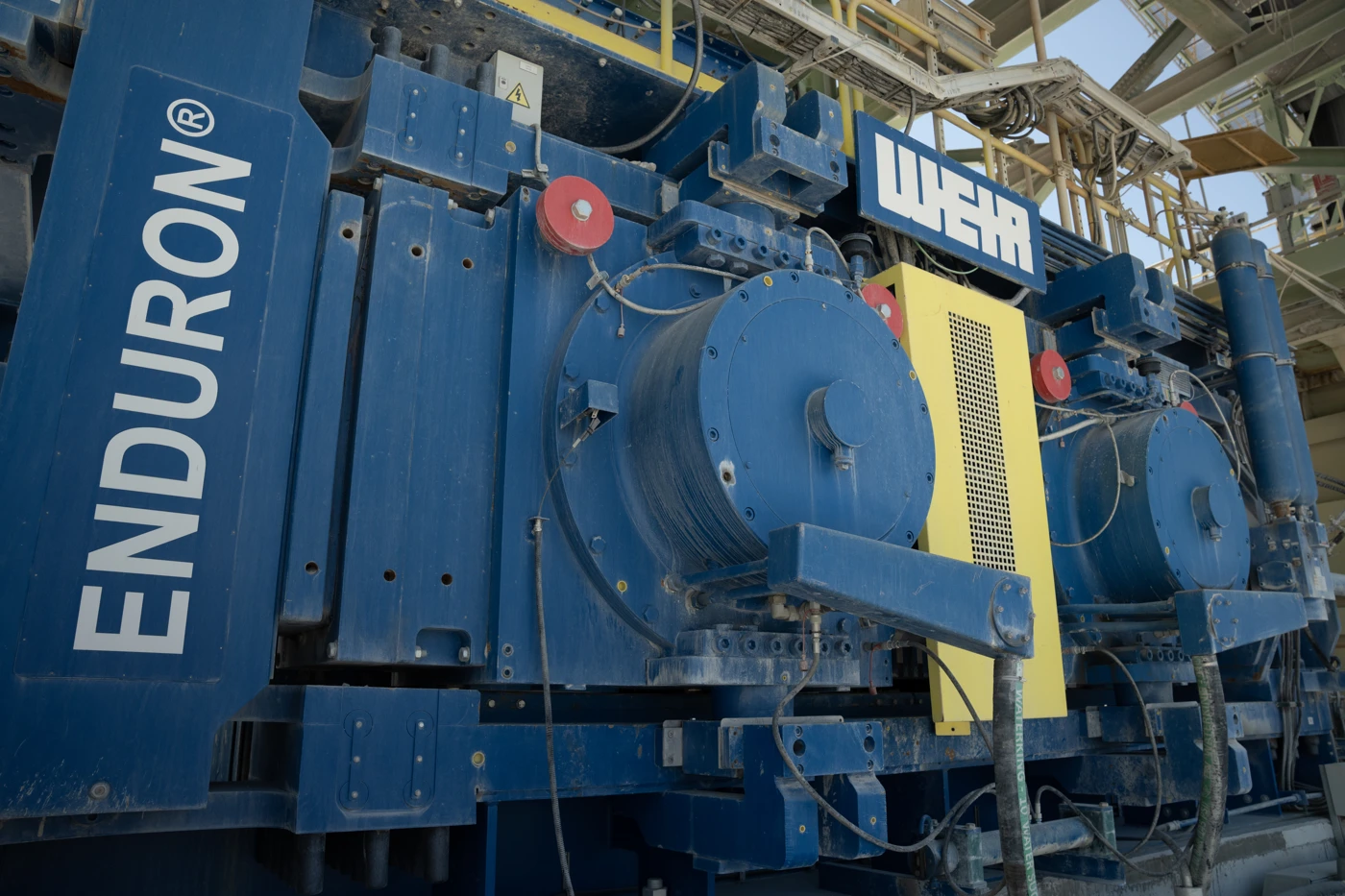
Weir’s ENDURON High pressure grinding rolls.
Q. Weir acquired SentianAI earlier this year. How can AI help miners optimise their operations?
Weir and SentianAI mirror each other’s approach: both are focused on harnessing digital technologies to optimise entire circuits and processes, rather than simply improving the performance of individual pieces of equipment. This is why the acquisition made perfect sense. Each company is an expert in their respective fields: Weir with libraries of product and application data, coupled with decades of success in process optimisation services, and SentianAI with a proven track record of taking large data sets and successfully applying AI to improve mining processes.
SentianAI’s technology will extend and expand Weir’s current capabilities and turn current process optimisation services into real-time digital solutions. Some operators are already using advanced process control (APC) solutions. Weir’s Intelligent Assistant can either sit on top or in conjunction with the APCs, or stand completely alone, and will utilise AI to do predictive and simulation-based process recommendations, enabling our customers to monitor and tailor their approach to meet their specific objectives – whatever they may be.
The merging of SentianAI’s capabilities and Weir’s knowledge opens the door for a new generation of supervisory control systems focused on process optimisation. This new generation of supervisory control will, in time, cover the entire processing flowsheet, with the initial focus being comminution and the mill circuit.
This is the direction the industry is heading and Weir is in an enviable position – as a company that has both the digital capabilities, but also a long history in mining – to bridge what can often feel like a divide between the aspirations and future-focused visions of startups and the day-to-day realities of what happens on a mine site.
Q. How can technology be used to make operations more sustainable?
Martin Rugfelt, Weir Minerals, Director of Intelligent Operations said:
By having a holistic picture of the process at any given point of time, we can provide optimised setpoints for the operation. Take, for example, an HPGR circuit. The feed isn’t always consistent, so when the ore characteristics change – say it becomes harder or softer – then Weir’s intelligent solution recognises that in real-time and adjusts the roll speed and pressure, ensuring the HPGR is operating optimally and, thus, reducing energy consumption.
Q. What technology developments do you predict for the next year or so in the sector?
Apart from AI powered applications, I don’t necessarily think it will be technological developments that will make the most impact in the next few years; rather, it will be more widespread adoption and integration of existing digital technologies. For instance, there seems to be a recognition that converging IT and OT will streamline operations and deliver efficiencies, but there’s been a lag across the sector in getting the required data policies and governance frameworks in place for that to happen. But, as customers get a better understanding of the value that integrating front-end solutions with backend systems can deliver in terms of closed loop operations and higher degree of autonomy and efficiency, I think we’ll see a sharp uptick in the adoption of digital solutions.
The mining industry has traditionally been very siloed, but as data-based insights are more widely used to improve all parts of the value chain I think we’ll see miners take a more holistic approach. Data can provide an end-to-end perspective, allowing miners to understand what impact, say, material properties and wear have on process performance and vice versa.


 Abmec
Abmec